The rise of collaborative intelligence: Why the future belongs to humans and AI
Lorem ipsum dolor sit amet, consectetur adipiscing elit. Ut elit tellus, luctus nec ullamcorper mattis, pulvinar dapibus leo.


Lorem ipsum dolor sit amet, consectetur adipiscing elit. Ut elit tellus, luctus nec ullamcorper mattis, pulvinar dapibus leo.
The narrative around artificial intelligence has long been dominated by a single, unsettling question: Will AI replace humans? From factory floors to corporate boardrooms, the fear of automation displacing human effort has shaped both public perception and enterprise strategy. But this framing misses the bigger picture. We are not entering an era of human vs. machine. We are entering an era of human with machine that shows a paradigm known as collaborative intelligence. Collaborative intelligence represents a fundamental shift in how work gets done. Instead of viewing AI as a replacement, forward-thinking organizations are leveraging it as an augmentation layer that is helping to enhance human capabilities, accelerating decision-making, and unlocking new forms of creativity and efficiency. The future doesn’t belong to AI alone. It belongs to those who learn how to work with it. From automation to augmentation The early waves of AI adoption were focused heavily on automation. It was mostly centered around replacing repetitive, rule-based tasks with machines. This made sense. Tasks like data entry, invoice processing, and basic customer support were predictable and structured, making them ideal candidates for automation. But as AI systems have evolved especially with advancements in large language models and adaptive learning, they’ve moved beyond rigid workflows. Today’s AI can interpret context, generate content, analyze complex datasets, and even engage in nuanced conversations. This evolution has shifted the focus from automating a task to augmenting the capability. Instead of asking, “What tasks can AI take over?” organizations are now asking, “How can AI make our people more effective?” This is where collaborative intelligence begins. What is collaborative intelligence? Collaborative intelligence is the integration of human judgment and machine intelligence to achieve outcomes neither could accomplish alone. Humans bring context, creativity, empathy, and ethical reasoning. AI brings speed, scalability, pattern recognition, and data processing power. Individually, both have limitations: Humans are constrained by time, cognitive load, and bias. AI is limited by training data, lack of true understanding, and absence of intent. Together, they compensate for each other’s weaknesses. Consider a marketing team. AI can analyze millions of data points to identify trends, segment audiences, and even generate campaign drafts. But it takes human intuition to interpret cultural nuances, craft a compelling narrative, and align messaging with brand identity. Or take healthcare. AI can detect anomalies in medical imaging with remarkable accuracy, but it’s the physician who contextualizes those findings within a patient’s broader condition and makes the final call. Collaborative intelligence is centered around creating a feedback loop between humans and machines. Why collaborative intelligence is gaining momentum Several forces are accelerating the rise of this model: Explosion ofdata Organizations today generate more data than ever before especially in segments like customer interactions, operational metrics, and market signals. Human teams alone cannot process this volume efficiently. Therefore, AI becomes essential as a co-pilot. Need forspeed and agility Markets are evolving rapidly. Decisions that once took weeks now need to happen in real time. AI enables faster analysis and execution, while humans ensure those decisions remain aligned with strategy and ethics. Increasingcomplexity of work Modern business problems are multi-dimensional. They require both analytical depth and contextual understanding. Collaborative intelligence allows organizations to tackle this complexity more effectively. Shift inworkforce expectations Employees don’t just want tools but want the leverage. AI provides that leverage, enabling individuals to do more impactful work rather than being bogged down by repetitive tasks. Real-world applications of collaborative intelligence Collaborative intelligence is reshaping industries in these many ways: Sales andlead generation AI agents can identify high-intent prospects, analyze behavioral signals, and even initiate conversations. But closing a deal still depends on human rapport, negotiation, and trust-building. The result is simple. Sales teams spend less time chasing cold leads and more time engaging with qualified opportunities. Customersupport AI handles routine queries instantly, reducing wait times and operational load. When conversations become complex or emotionally sensitive, they are escalated to human agents. This hybrid approach improves both efficiency and customer satisfaction. Contentcreation andmarketing AI can generate drafts, optimize SEO, and personalize messaging at scale. Humans refine tone, ensure originality, and align content with brand voice. Instead of replacing marketers, AI transforms them into strategic storytellers. Productdevelopment AI can simulate scenarios, analyze user feedback, and predict feature adoption. Human teams use these insights to make informed design and roadmap decisions. Finance andriskanalysis AI identifies anomalies and patterns in financial data far faster than traditional methods. Human analysts validate these insights and apply judgment in high-stakes decisions. The human advantage in an AI-driven world As AI capabilities expand, the value of distinctly human skills becomes even more pronounced. Creativity AI can generate variations. However, it will always require human strength for being able to connect ideas and bring something meaningful out of it. Emotionalintelligence Understanding human emotions, building relationships, and navigating complex social dynamics are areas where humans excel. Ethicaljudgment AI operates on data and rules. It doesn’t possess moral reasoning. Humans are essential for ensuring decisions align with societal values and organizational principles. Strategicthinking AI can provide insights, but defining vision, setting priorities, and making trade-offs require human leadership. In a collaborative intelligence model, these skills become the differentiators. The AI advantage: What machines do best To understand collaboration, it’s equally important to recognize what AI brings to the table: Scale and Speed AI can process massive datasets in seconds. Humans would require a considerabletimeframe to perform the task. Patternrecognition It can detect trends and correlations that might go unnoticed by human analysts. Consistency Unlike humans, AIdoesn’t suffer from fatigue or variability in performance. Continuouslearning AI systems improve over time as they are exposed to more data and feedback. When these capabilities are paired with human strengths, the result is exponential productivity. Challenges in building collaborative intelligence Despite its promise, implementing collaborative intelligence is not without challenges. Trust andadoption Employees may be hesitant to rely on AI, especially if they don’t understand how it works. Building trust requires transparency and education. Integration withexisting workflows AI systems must seamlessly integrate into current processes. Poor integration can lead to friction rather than efficiency. Dataquality andbias AI is only as good as the data it learns from. Inaccurate or biased data can lead to flawed outcomes. Redefiningroles andskills As AI takes over certain tasks, job roles will evolve. Organizations must invest in upskilling their workforce to thrive in this new environment. Designing for collaboration, not replacement To truly harness collaborative intelligence, organizations need to rethink how they design systems and workflows. Instead of asking, “Where can we remove humans?” the better question is: “Where do humans and AI create the most value together?”
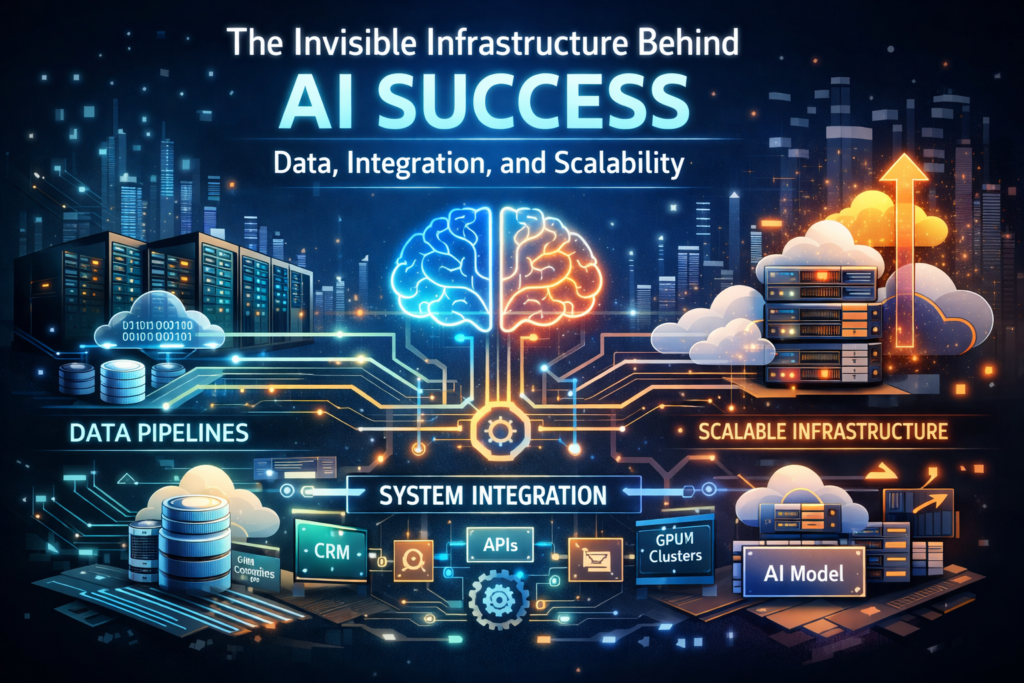
The invisible infrastructure behind AI success: data, integration, and scalability Artificial Intelligence has officially moved past the experimentation phase. And with that businesses are now measuring the impact. On the surface, AI success stories look simple. A model is trained, predictions improve, processes automate and revenue grows. But beneath every successful AI deployment lies something far less glamorous but equally important – the infrastructure. Infrastructure is not just about servers and GPUs but also about data pipelines, system integrations, governance layers, monitoring frameworks, scalable architectures and a lot more. However, the harsh truth is, AI may fail, not because of the algorithms but because the invisible infrastructure behind it was never built properly. At Deepmindz, we have seen this pattern across industries. Enterprises invest in AI models but underestimate the foundational layers required to make those models reliable, secure, scalable, and aligned with business objectives. This blog explores the three pillars of invisible AI infrastructure: Data, Integration, and Scalability in addition to exploring and how Deepmindz builds them end-to-end for enterprise success. Data: The real competitive advantage Data is goldmine for modern businesses. However, sometimes business fail with its execution despite having in-depth insights. This is where the role of a tech partner becomes prominent. The enterprise data reality In most enterprises, data is deeply fragmented across systems. Customer data sits inside CRM platforms, while operational data resides in ERP systems. Marketing insights remain locked within automation tools, and support conversations are scattered across chat, voice, and ticketing platforms. Meanwhile, legacy systems continue to store years of historical records in incompatible formats. Instead of a unified intelligence layer, organizations are left managing isolated data silos that limit the true potential of AI. AI cannot generate meaningful insight from fragmented silos. Additionally, without structured, clean, governed, and contextualized data: Models produce inconsistent outputs. Predictions drift. Insights lack business relevance, and Trust erodes across teams. However, AI-ready data can easily change the game because the data is: Clean and deduplicated Contextually tagged Unified across systems Governed by access policies Continuously updated, and Monitored for drift This requires far more than exporting CSV files into a model training pipeline. It requires a complete architecture capable of storing, churning and making the data useful for business. How Deepmindz approaches data infrastructure Deepmindz begins every enterprise AI journey with a data maturity assessment. In addition to this, before building models, we ask: Is the data complete? Is it consistent across systems? Who owns governance? What compliance frameworks apply? How will data evolve over time? The following information helps us design: Centralized or hybrid data architectures Real-time data pipelines API-based ingestion frameworks Data validation layers Governance and compliance mechanisms Only once the data foundation is stable do we move to model development. Integration: AI cannot live in isolation One of the biggest misconceptions about enterprise AI is that it functions as a standalone product, which is not correct. An AI model that cannot integrate into workflows becomes a dashboard. Having a dashboard is good for centralized information at a place but that does not transform a business. Transformation happens when AI integrates seamlessly into decision-making systems. The integration gap Enterprises often face these challenges: AI outputs exist in separate tools. Sales teams don’t trust model recommendations. Operations teams revert to manual processes. Insights are not embedded into daily workflows. Adoption stalls after pilot phases. The problem is not model accuracy but workflow friction. AI must be an important component and should play an important role when decisions are made. How Deepmindz solves integration challenges Deepmindz focuses heavily on enterprise system integration right from the time when projects are initiated. There is a step-by-step process, where, we: Map AI outputs directly to business KPIs. Integrate models into CRM, ERP, marketing automation, support platforms, and custom systems. Develop APIs and middleware to enable real-time synchronization. Ensure minimal disruption to existing workflows. Design user interfaces aligned with enterprise processes. We do not deploy AI as a separate island. We embed intelligence into the systems enterprises already use while ensuring adoption, trust, and measurable ROI. Because AI adoption is not about technology but about behavior change. And behavior changes only when intelligence becomes invisible yet indispensable. Scalability: From pilot to enterprise-grade deployment Many enterprises successfully complete AI pilots. But only few successfully scale them. Because scaling AI is fundamentally different from building AI. The pilot trap During pilot phases: Data volumes are limited. Use cases are controlled. Risk is minimal. Teams are small. Infrastructure is flexible. But once AI moves to enterprise-wide deployment: Data volume multiplies. User base expands. Performance expectations increase, and Failure becomes costly. A model that works for 10,000 records may collapse under 10 million. It thus becomes important that scalability must be thought from the beginning. How Deepmindz engineers for scale Deepmindz designs AI systems with long-term scalability in mind. We have a structured approach that includes: ModulararchitectureEach AI component like processing, inference and monitoring is designed independently yet interoperable. MLOpsframeworks We implement automated pipelines for: Continuous training Version control Deployment rollbacks, and Performance tracking Monitoring &governanceEnterprise AI requires oversight and therefore we build: Drift detection systems Bias monitoring frameworks Audit trails, and Compliance-ready documentation Infrastructureoptimization AI success is not just about building smarter models but building smarter infrastructure. At Deepmindz, we align compute power with cost efficiency, ensuring enterprises scale without falling into the trap of infrastructure dysfunctioning because scaling AI is not merely technical expansion. It is about operational maturity and the ability to handle growing data volumes, rising user demand, complex integrations, and evolving workloads without performance bottlenecks or runaway costs. True scalability means your systems grow intelligently, your resources are optimized continuously, and your AI remains reliable under pressure. That’s the invisible infrastructure advantage. And Deepmindz builds both the intelligence and the backbone that sustains it. The Deepmindz end-to-end AI development framework What differentiates Deepmindz is not just model expertise but orchestration. Therefore, we offer enterprises a complete lifecycle approach step-by-step: Strategic discovery The very first step includes the following: Business objective alignment ROI modeling Use case prioritization Feasibility analysis As we move forward with the above-mentioned details, our professionals move to the next step of data engineering. Data engineering Data audits Pipeline creation Cleaning and enrichment Governance frameworks The third step includes model development. AI model development Custom model design LLM integration Predictive modeling Computer vision / NLP solutions After that comes integrating the system. System integration API development CRM/ERP embedding Workflow automation UI/UX alignment Deployment includes Deployment & MLOps Cloud-native infrastructure Continuous deployment pipelines Monitoring dashboards Risk management systems And the final step comes as scaling. Scale & Optimization Performance tuning Cost optimization Retraining strategies Expansion to new use cases Why enterprises need infrastructure-first AI The AI conversation has shifted from whether AI works to how much it is scalable, secure, and reliable. Enetrprises who are successfully implementing AI share one common trait. They treat AI as infrastructure, not experimentation. They
AI At the Core: Why Digital Transformation Is Incomplete Without Artificial Intelligence Various examples of digital transformation have been making all the news since past some decades. And to keep up the pace businesses around the world have digitized processes by moving to the cloud, embracing automation, and building new digital experiences for customers. But the truth that many organizations have lately realized is digitization alone isn’t transformation. Of course, we can digitize workflows, migrate systems, and automate tasks, but without intelligence at the core, we are only scratching the surface of what technology can do. And that is why Artificial Intelligence (AI) is the required tool, that can ensure transformation at the core. From digitization to intelligence: the next leap Let’s rewind a bit.The first wave of digital transformation focused on digitizing data. It was centered more around turning paper into pixels, manual logs into databases, and face-to-face interactions into digital touchpoints. Moving ahead, the second wave emphasized more on automation wherein technology was used to make repetitive tasks faster and cheaper. However, the third and probably the most transformative wave that has been has been redefining industries today is about making systems intelligent. With artificial intelligence it is not only about automating but also about making systems smarter so that they can learn, adapt and predict. The goal thus lies in transforming static systems into dynamic ones while ensuring they can offer personalize experiences, can make decisions and continuously improve themselves. Why digital transformation without AI falls short While choosing to “go digital” may be the next big leap for many organizations. There are still challenges that technology alone hasn’t solved: Data overload but insight scarcity: Massive data collection, yet little clarity on what it means. Automation without adaptability: Processes are fast, but not always smart. Customer touchpoints without personalization: Digital experiences exist, but they’re one-size-fits-all. The sole reason for these gaps to exist is digital systems operate on logic. However, with AI systems operate on learning. With traditional transformation, digital tools only follow the rules you give them. But AI learns based on data, context, and outcomes. Therefore, AI or artificial intelligence fills the gap while evolving the ecosystem. AI at the core: the difference it makes Embedding AI into the core of your digital ecosystem unfolds a lot of benefits. Not only it transforms the business but also provides the capability to think, act, and grow. Here’s how: Data to Decisions Digital tools are essential to collect data whereas AI helps to understand it. AI-driven analytics help organizations to move from dashboards that describe “what happened” to systems that predict what will happen next followed by a recommendation for next best course of action. This turns raw data into actionable intelligence ensuring faster decision making. Personalization at Scale In today’s digital world, it’s the relevance plus convenience that matters for customers. With AI, businesses have the capability of delivering hyper-personalized experiences by analyzing behavior, intent, and preferences in real-time. Systems powered by AI like recommendation engines, adaptive pricing, or personalized chatbots learn and refine continuously due to their ability. With AI personalization becomes precision not a guesswork. Automation That Thinks Traditional automation runs on pre-defined rules. However, automation powered by AI creates rules. AI in the system ensures intelligent document processing while also ensuring workflows to adapt and optimize themselves based on feedback and outcomes. This transforms businesses to be intelligently adaptive and therefore, capable of handling complexity without constant human intervention. Predictive Agility At a time when markets change fast, AI helps you stay ahead by forecasting trends, identifying risks, and spotting opportunities before they appear. AI’s foresight into digital systems like predictive maintenance in manufacturing, demand forecasting in retail, and sentiment analysis in marketing ensures the systems are well adapted to anticipate the change. Innovation that never stops Innovation becomes continuous when AI becomes part of your digital core. This ensures your system is being taught every few hours instead of redesigning the entire infrastructure. A well-structured system in place thus helps organizations move from digital maturity to digital mastery. The DeepMindz perspective: building AI at the core At DeepMindz, we focus on developing intelligence-first design with a belief that the future of digital transformation lies in systems that are capable enough to ensure automation. We help organizations not just adopt AI but build with it at the core of their systems. From idea to MVP, our approach ensures that every solution learns, adapts, and scales intelligently. Here’s how we make it happen: Discover: Identify high-impact opportunities where AI can deliver measurable value. Design: Architect data flows, models, and experiences that align with business goals. Build: Rapidly prototype AI solutions that are functional, testable, and scalable. Scale: Optimize and expand systems to integrate AI deeply into business operations. The Future Is Intelligence-Led As tech and industries evolve, digital transformation without AI will soon feel like driving without navigation. You might move ahead but it will be as fast as it must. Also, you might not necessarily be moving in the right direction. At the core AI doesn’t replace your digital strategy but completes it. It bridges the gap between technology and intelligence turning systems into learners, data into insight, and operations into adaptive ecosystems. Final Thought Digital transformation was the first step. AI-driven transformation is the destination. To lead in tomorrow’s world, businesses need more than digital adoption they need AI at the core. A decade ago, digital transformation was considered a strategic differentiator. Today, it is “table stakes.” Artificial Intelligence has now taken that position not as a future innovation, but as a present-day foundation for competitive business operations. AI is embedded in how modern businesses sell, serve, forecast, and scale. According to McKinsey, companies that have embedded AI deeply into their operations are already seeing 20–30% improvements in efficiency and double-digit revenue growth compared to laggards. The competitive landscape has shifted. Customers expect instant responses, personalized experiences, and seamless journeys across touchpoints. Markets move faster, margins are tighter, and operational complexity continues to rise. In this environment, waiting to

From AI in motion to AI at scale: Operationalizing intelligence across the enterprise The mainstream of AI, generative AI in particular, is continually evolving. From being a concept that companies were hesitant to accept, AI has now emerged as one of the most desired technological evolutions this year. Moving from AI adoption to AI implementation and now to AI in motion, the technology has evolved to create real measurable value. With AI, pilots run successfully, agents automate workflows, and early wins build confidence across teams. The AI in motion is great; however, motion without scale is fragile. Many enterprises have experienced the halt happening between adoption and implementation phase in case the data volume increases. With added data, what worked once becomes difficult to replicate consistently. This is where operational intelligence across enterprises comes in action, which brings us to the next frontier, which is operationalizing “AI at scale.” This means making AI repeatable across use cases, reliable under real-world conditions, and scalable across teams, systems, and geographies. When it comes to operationalizing intelligence, it requires strong foundations to ensure the next frontier is intelligent, reliable and scalable. What AI at Scale Really Means (And What It Doesn’t) AI at scale isn’t about deploying more models, stacking bigger datasets, or running larger pilots across teams. What AI at scale really means is the ability to make intelligence reliable, repeatable, and durable across the enterprise. True scale shows up when AI systems deliver consistent outcomes. When they are resilient enough to handle real-world variability including changing data, edge cases and system failures without breaking. When governance is built in by design, ensuring models are monitored, compliant, auditable, this continuously strengthens the system instead of resetting it. AI at scale performs across geographies, teams, and time whether it’s a sales agent in one market or an operations workflow in another. It adapts, learns, and integrates seamlessly into daily work. In short, AI at scale isn’t about how much AI you deploy; it’s about how well it holds up when the organization depends on it. The Hidden Barriers to Scaling AI Scaling with AI has become enormously easy, there are certain hidden barriers that surrounds the operations. Fragmented architectures sometimes create silos where teams build duplicated models, pipelines, and logic. This may further lead to inconsistency, higher costs, and systems that don’t generalize across use cases or regions. In addition to this, several “automated” workflows still rely on manual dependencies, most importantly on human approvals or hardcoded handoffs. These elements have a direct impact on the system and may result in breaking speed, limit autonomy, and deter AI from continuously operating at enterprise scale. Another silent blocker comes in the form of governance gaps. In regulated customer-facing environments where a clear framework often defines the path for security, compliance, accountability, and explainability, organizations struggle to trust AI outputs. Finally, the consequence may come in the form of performance decay where AI systems suffer without having structured feedback loops and retraining. True scale demands integrated architectures, real autonomy, strong governance, and continuous learning. Parameters any less than these stalls progress. Designing for Scale: The Enterprise AI Operating Model Designing AI scaling enterprises is all about building models that are easy to adapt, coordinate and learn method across the enterprises. This requires architecture capable of rethinking, workflows that can adapt to modern requirements and accountability from the ground up. With the recent technical advancement modular, agent-based architectures are capable of breaking monolithic AI systems into specialized, autonomous agents ensuring each one is responsible for a discrete task such as forecasting, recommendation, qualification, or compliance checks. Among various other benefits that come along, AI agents can be independently upgraded, reused across teams, and orchestrated together to solve complex business problems. Modularity enables faster iteration, reduces dependency risk, and prevents duplication as AI use cases expand. Event-driven systems replace static pipelines by allowing AI to respond in real time to signals like customer actions, system updates, and market changes rather than waiting for scheduled batch processes. Irrespective of any request, events can dynamically trigger agents and enable adaptive workflows Shared intelligence services across functions ensure that core capabilities (that includes customer understanding, risk scoring, decision logic, or language intelligence are built once and consumed everywhere. This creates consistency in decisions, compounds of learning across departments, and prevents fragmented AI efforts. Finally, built-in observability and performance monitoring make AI systems measurable and trustworthy. Continuous tracking of accuracy, latency, drift, cost, and outcomes allows teams to detect degradation early, retrain intelligently, and maintain reliability as systems grow. Together, these principles turn AI into a scalable, enterprise-grade capability. DeepMindz POV: Scaling Intelligence, Not Just Technology At DeepMindz, scaling AI is not about deploying more tools, models, or automationsautomation. It is very much about scaling intelligence as a living system that grows stronger over time. Technology enables intelligence, but intelligence only scales when it is designed to learn and adapt. We also focus on designing for durability and growth, which means building AI systems with long-term resilience in mind. DeepMindz architects modular, agent-driven systems that can evolve as business needs to change with new data sources, new markets, and new regulations without requiring constant rebuilds. Governance, observability, and feedback loops are embedded from day one, ensuring systems remain reliable, secure, and performant as they scale. Additionally, DeepMindz creates shared intelligence layers including customer understanding, decision engines, workflow orchestration (that sync power multiple functions ) simultaneously. This transforms AI from a point solution into a foundational enterprise capability. Most importantly, DeepMindz ensures AI compounds value with every interaction. Each decision, outcome, and user signal feeds back into the system, improving future performance. Over time, the organization doesn’t just use AI, it builds an intelligence advantage that continuously multiplies. Conclusion: Scale Is Where AI Becomes a Competitive Weapon AI becomes truly transformative only when it moves beyond pilots. At scale, AI shifts organizations from reacting to problems to anticipating them before they surface. This transition creates consistency in building resilience, and value across functions and geographies. Enterprises that successfully scale intelligence build systems that learn continuously and improve with every interaction. In contrast, organizations that merely experiment with AI remain stuck in short-term wins, unable to translate innovation into sustained competitive advantage.

From AI at the Core to AI in Motion: Building an Intelligence-Driven Enterprise As an extended part of our very first rollout “AI at the core: why digital transformation is incomplete without artificial intelligence”, it is safe to say; AI or artificial intelligence is the core for a meaningful digital transformation. Understanding why it matters is the next subject we will be discussing here in detail. This next phase will also cover: how enterprises operationalize intelligence, embed it into their architecture, and turn strategy into execution. For CEOs and CTOs the movement to be in the AI ecosystem is no longer simply about assessing AI tools or evaluating isolated use cases. They are now responsible for architecting AI-powered organizations, where intelligence is woven into the very fabric of how the business runs. The competitive advantage lies not in adopting AI, but in enabling it to move freely across the enterprise. This blog introduces the idea of AI in motion, meaning shifting from AI adoption to its implementation where AI continuously flows through workflows, decisions, and customer interactions. The Intelligence-Driven Enterprise: What It Really Means Having an intelligence-driven enterprise ensures the foundation is AI-first and core workflows are AI powered defined by autonomous processes, self-optimizing systems, and real-time decision loops that continuously learn, adapt, and act without human prompting. In such workflows AI becomes an entire operating layer of the business and not just a tool. Adopting AI entirely helps organizations to avoid the risk of keeping AI only in fragments, which may further create silos, inconsistent decision-making, and manual bottlenecks that slow everything down. However, an intelligent flow across functions enables the enterprise to operate with speed, precision, and compound efficiency gains. The Three Layers of an AI-Integrated Enterprise AI-integration in enterprises can be a three-layer interconnection aimed to align leadership, technology, and execution. At the core is the Intelligence Layer, which can be referred as the “brain” of the organization. This is the organizational layer where real-time models, adaptive logic, and multimodal understanding continuously process data. As the data grows, this layer matures from simple descriptive analytics to predictive, prescriptive, and eventually autonomous decision-making capabilities. Second layer surrounding it is the “Integration Layer”, which in simple terms can be organization’s “nervous system,” built on APIs, microservices, event streams, and agentic frameworks. Its purpose is to ensure that AI insights don’t just remain theoretical but every output flows seamlessly into operational actions. The last and the final layer can be the “Experience Layer” which would further act as the “face” of the enterprise. This will remain responsible for shaping how customers, employees, and partners interact with intelligence. Through adaptive, human-centric interfaces, this layer delivers AI-driven value in clear, intuitive ways. Working together, these three layers create a unified architecture that turns intelligence into real, measurable business impact. The Real Challenge: Turning AI Strategy into Execution For most CEOs and CTOs, the challenge in AI adoption and further in its execution is not why but How and where to start. While the vision with this often remains clear, it is at the execution level where structural barriers halt the process. Furthermore, data silos prevent forming a unified intelligence, Legacy tech stacks resist integration and slow down automation. Added to that, skill gaps limit an organization’s ability to build, deploy, and maintain AI systems. Misaligned KPIs make teams optimize for outputs instead of outcomes. And many companies fall into the trap of experimentation without scalability, running disconnected pilots that never evolve into enterprise-wide impact. Turning a well-developed strategy into action needs the required shift from isolated AI initiatives to a systematic, layered approach: modernize data foundations, redesign workflows for automation, adopt scalable agentic frameworks, and align leadership around measurable AI-led outcomes. This structured path is what converts AI ambition into operational reality. The AI Integration Blueprint (The DeepMindz POV) The DeepMindz AI Integration Blueprint provides leaders with a clear, practical path to move from AI experimentation to enterprise-wide transformation. We have a predefined step-by-step workflow to get AI-integration embedded into the system. This blueprint helps to bridge strategy and execution while ensuring AI becomes a living, evolving capability inside the organization. Conclusion: AI in Motion Defines the Next Competitive Frontier Digital maturity is the baseline and a must-have component for organizations today. As businesses are growing bigger on automation, advanced tools and next-gen platforms; the most essential component that organizations cannot miss on while riding this automation wave is intelligence maturity. This shift from using technology to do more, to building intelligent systems that think, adapt, and elevate outcomes on their own helps to take decisions that are data driven. The shift also ensures the workflows are autonomous, and teams operate with AI as a strategic partner. Businesses that embrace this evolution move faster, respond smarter and scale without friction. Those that don’t; risk getting stuck in outdated digital routines while competitors accelerate ahead.