
From AI at the Core to AI in Motion: Building an Intelligence-Driven Enterprise
As an extended part of our very first rollout “AI at the core: why digital transformation is incomplete without artificial intelligence”, it is safe to say; AI or artificial intelligence is the core for a meaningful digital transformation. Understanding why it matters is the next subject we will be discussing here in detail.
This next phase will also cover: how enterprises operationalize intelligence, embed it into their architecture, and turn strategy into execution.
For CEOs and CTOs the movement to be in the AI ecosystem is no longer simply about assessing AI tools or evaluating isolated use cases. They are now responsible for architecting AI-powered organizations, where intelligence is woven into the very fabric of how the business runs. The competitive advantage lies not in adopting AI, but in enabling it to move freely across the enterprise.
This blog introduces the idea of AI in motion, meaning shifting from AI adoption to its implementation where AI continuously flows through workflows, decisions, and customer interactions.
The Intelligence-Driven Enterprise: What It Really Means
Having an intelligence-driven enterprise ensures the foundation is AI-first and core workflows are AI powered defined by autonomous processes, self-optimizing systems, and real-time decision loops that continuously learn, adapt, and act without human prompting.
In such workflows AI becomes an entire operating layer of the business and not just a tool. Adopting AI entirely helps organizations to avoid the risk of keeping AI only in fragments, which may further create silos, inconsistent decision-making, and manual bottlenecks that slow everything down. However, an intelligent flow across functions enables the enterprise to operate with speed, precision, and compound efficiency gains.
The Three Layers of an AI-Integrated Enterprise
AI-integration in enterprises can be a three-layer interconnection aimed to align leadership, technology, and execution.
At the core is the Intelligence Layer, which can be referred as the “brain” of the organization. This is the organizational layer where real-time models, adaptive logic, and multimodal understanding continuously process data. As the data grows, this layer matures from simple descriptive analytics to predictive, prescriptive, and eventually autonomous decision-making capabilities.
Second layer surrounding it is the “Integration Layer”, which in simple terms can be organization’s “nervous system,” built on APIs, microservices, event streams, and agentic frameworks. Its purpose is to ensure that AI insights don’t just remain theoretical but every output flows seamlessly into operational actions.
The last and the final layer can be the “Experience Layer” which would further act as the “face” of the enterprise. This will remain responsible for shaping how customers, employees, and partners interact with intelligence. Through adaptive, human-centric interfaces, this layer delivers AI-driven value in clear, intuitive ways.
Working together, these three layers create a unified architecture that turns intelligence into real, measurable business impact.
The Real Challenge: Turning AI Strategy into Execution
For most CEOs and CTOs, the challenge in AI adoption and further in its execution is not why but How and where to start. While the vision with this often remains clear, it is at the execution level where structural barriers halt the process. Furthermore, data silos prevent forming a unified intelligence, Legacy tech stacks resist integration and slow down automation.
Added to that, skill gaps limit an organization’s ability to build, deploy, and maintain AI systems. Misaligned KPIs make teams optimize for outputs instead of outcomes. And many companies fall into the trap of experimentation without scalability, running disconnected pilots that never evolve into enterprise-wide impact.
Turning a well-developed strategy into action needs the required shift from isolated AI initiatives to a systematic, layered approach: modernize data foundations, redesign workflows for automation, adopt scalable agentic frameworks, and align leadership around measurable AI-led outcomes. This structured path is what converts AI ambition into operational reality.
The AI Integration Blueprint (The DeepMindz POV)
The DeepMindz AI Integration Blueprint provides leaders with a clear, practical path to move from AI experimentation to enterprise-wide transformation. We have a predefined step-by-step workflow to get AI-integration embedded into the system.
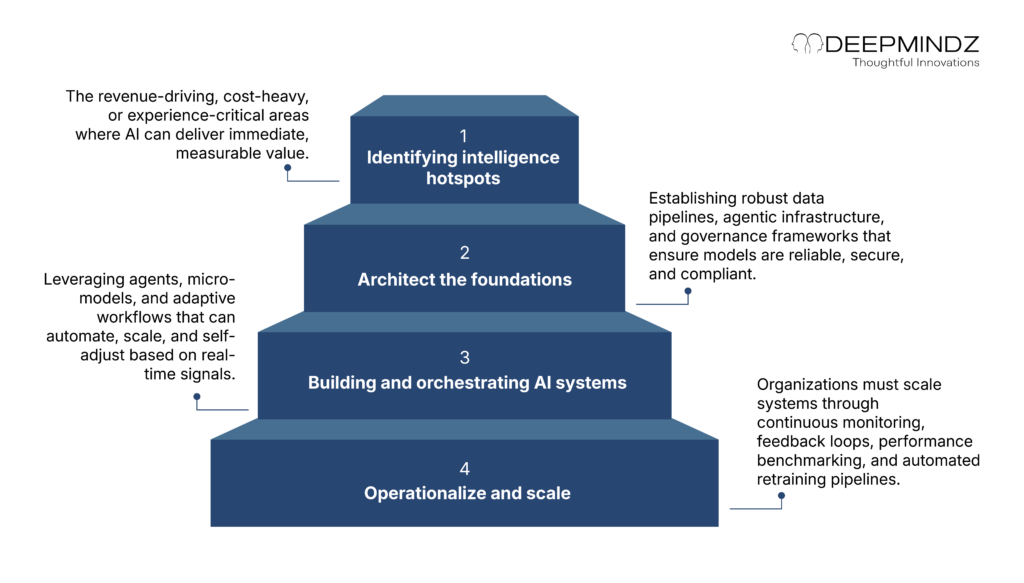
This blueprint helps to bridge strategy and execution while ensuring AI becomes a living, evolving capability inside the organization.
Conclusion: AI in Motion Defines the Next Competitive Frontier
Digital maturity is the baseline and a must-have component for organizations today. As businesses are growing bigger on automation, advanced tools and next-gen platforms; the most essential component that organizations cannot miss on while riding this automation wave is intelligence maturity.
This shift from using technology to do more, to building intelligent systems that think, adapt, and elevate outcomes on their own helps to take decisions that are data driven. The shift also ensures the workflows are autonomous, and teams operate with AI as a strategic partner. Businesses that embrace this evolution move faster, respond smarter and scale without friction. Those that don’t; risk getting stuck in outdated digital routines while competitors accelerate ahead.