
For most of the people, AI has become synonym to automation, an additional way to speed up processes, reduce manual effort and increase efficiency. Very often, artificial intelligence is viewed as a tool that takes on repetitive tasks and frees humans for more complex responsibilities. However, in reality, that is just the starting point.
AI today includes more than just simple automation. It’s reshaping how organizations across industries think, decide, and act instead of just “doing things faster”. AI is making organizations smarter by helping them take decisions that are driven by data. Additionally, for professionals at executive leadership positions, AI is much bigger than a tool for doing things faster.
Let’s have a look on how this shift is taking place through our newest discovery, “how AI is redefining decision-making in modern enterprises”, and why does it matter for modern enterprises.
AI for deciding what matters
AI has majorly been used for automating repetitive tasks. For example, chatbots answering routine queries from customers, answering to rule-based campaign triggers, supply-chain scheduling, etc. This remains an important part but what is changing now is organizations are now realizing AI’s value in decision-making. Therefore, for CMOs, the movement has gone from asking “how to automate email sends” to “How can we leverage AI to decide which segments should be targeted and when.
Real adoption in numbers
AI is not just hype. AI usage have expanded across enterprises. For example, as per the European Commission report, 41 % of large enterprises used AI technology, compared with about 11 % of small firms. Additionally, as per IBM Global AI Adoption Index 2023, 42 % of enterprises have deployed AI actively, while 40 % were in experimental phase.
A recent report on Asia-Pacific (APAC) found that a staggering 53% of organizations in APAC are already utilizing AI agents for completely automating their processes.
What “AI-powered decision-making” really entails
When we talk about AI’s capability beyond automation, it’s about referring to the following capabilities:
- Predictive insights: It includes forecasting outcomes (customer churn, campaign ROI, lifetime value) and choosing among options as per the insights.
- Prescriptive recommendations: Includes not just forecasting, but recommending the best action and even simulating alternative courses.
- Continuous optimisation and adaptation: For models to learn, it requires real-world outcomes while adjusting decisions dynamically such as bidding strategies.
- Governance, transparency & human-in-the-loop: As decisions becomes complex, organizations will require models that are more capable, reliable auditable, and aligned with KPIs.
For marketing leaders, this means having more information than just knowing “what happened”. This means your system must tell you what should happen next and why.
Why this shift matters now for CMOs
The data today is more complex and present in large volumes.
The marketing ecosystem today is fragmented and dynamic at the same time. Whether it’s data, customer touch-points or channels, every single attribute is available in abundance. For human teams synthesizing this data in an actionable time becomes a task. AI decision support thus introduces speed and meaning.
Competitive differentiation moves from execution excellence to decision excellence
With AI, anyone can automate email sends or optimize paid search. Therefore, the succeeding frontier needs to be which segment and which bids should be next. The winning will become easier for those who use AI for high impact decisions at scale and speed.
ROI scrutiny is higher than ever
The fact that CMOs must justify every penny spent provides room for AI-driven decision frameworks that help to showcase a bigger picture like “due to the usage of this model, we increased incremental ROI by X %.” This detail matters when figuring out the expenses.
Risk and governance are getting attention
When AI takes a wrong or biased decision like denying a loan for unfair reasons, it can deeply hurt the brand reputation. Additionally, government regulation and rules like GDPR must be complied for transparency. Therefore, AI systems must be built in a manner that they are auditable and explainable.
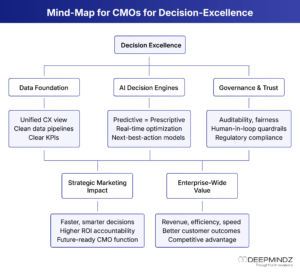
What a decision-centric AI operating model looks like
Here is a blueprint for additional understanding:
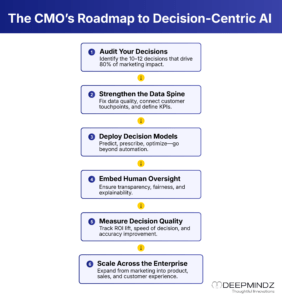
- Defining the decision remit: That entails knowing the high-stakes, high-impact decisions that your marketing team makes such as budget allocation by region, major channel shifts, creative portfolio decisions that AI can help make.
- Having an analytics foundation: This will help ensure the quality of data (high), unified customer view, clear KPIs, and more. Models can only perform excellent depending upon the quality of data behind it.
- Having models that can process with human-in-loop: Investing in AI ensures decision-support. However, the accountability must always remain with humans. This will foster trust and acceptability.
- Measuring decision outcomes: With AI it’s easy to move from measuring execution metrics (clicks, opens) to measuring the quality of decisions.
- Ensuring a decision-first culture: Keeping stakeholders on the same page by educating them on the current shift with “we help optimize every decision” instead of just saying we automate the task.
The near future
As AI systems will keep on maturing, we will watch decision-making move further upstream. The AI has already started being a part of strategic territory and the system impact will also move forward beyond campaign decisions to real business models, product market fit, brand positioning decisions and more.
For marketers this shift will dictate a movement that is not just restricted to execution but goes beyond to strategy. There will be more real-time decisions and not just syndicated reporting. Additionally, AI will be the part and a functional engine to decision making for faster execution.
In summary
Automation was the first wave of AI in marketing and now the second is decision-support. It is more strategic and beneficial for business. For CMOs, it’s not just about automating the marketing operations, but harnessing AI to make smarter and impactful decisions.
The tech is evolving, the means are becoming smarter; what will differentiate the leaders is how they will embed that technology into the decision fabric of the organization. This will help to shift marketing from being a cost-centre or execution engine to becoming a strategic decision-hub within the enterprise.